
Office pods for contact centres
You cannot put two hundred agents in pods, and anyone telling you otherwise has not run a floor. What a pod is for is the small proportion of conversations that cannot happen at a desk: the coaching session, the escalation, the client calibration call, the interview, the QA review. Those are the conversations currently happening in a stairwell or a borrowed boardroom, and they are the ones that decide whether your people stay. Every price is published below, in rand.
Six models, one configurator
Every FocusPod has a glass front and rear, built-in wheels and adjustable levelling feet.
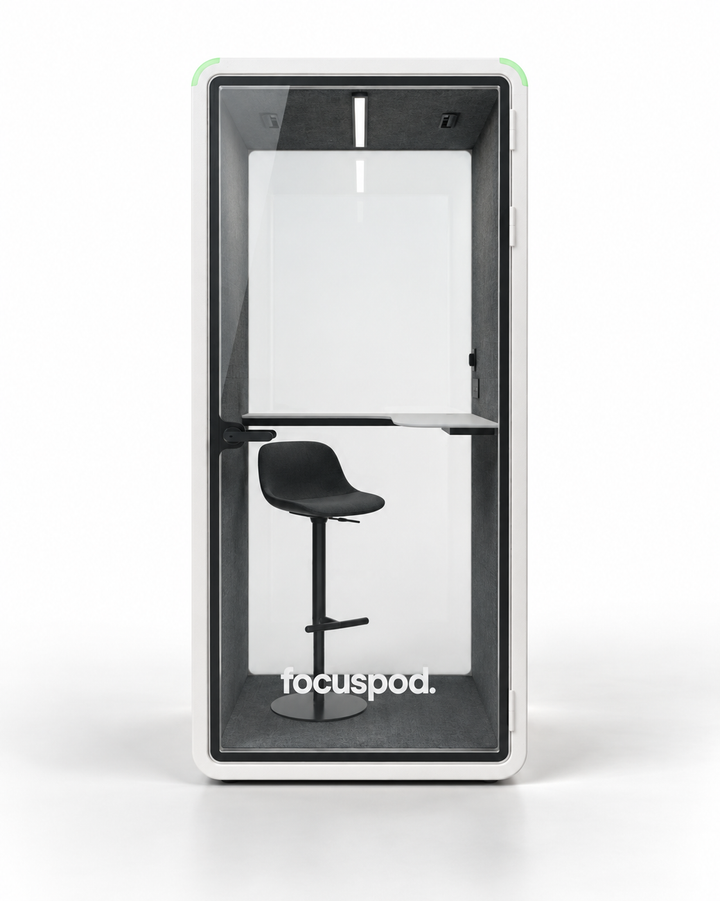 FocusPod Solo
R79,900 · Configure this model ↗
FocusPod Solo
R79,900 · Configure this model ↗ FocusPod Solo Plus
R99,900 · Configure this model ↗
FocusPod Solo Plus
R99,900 · Configure this model ↗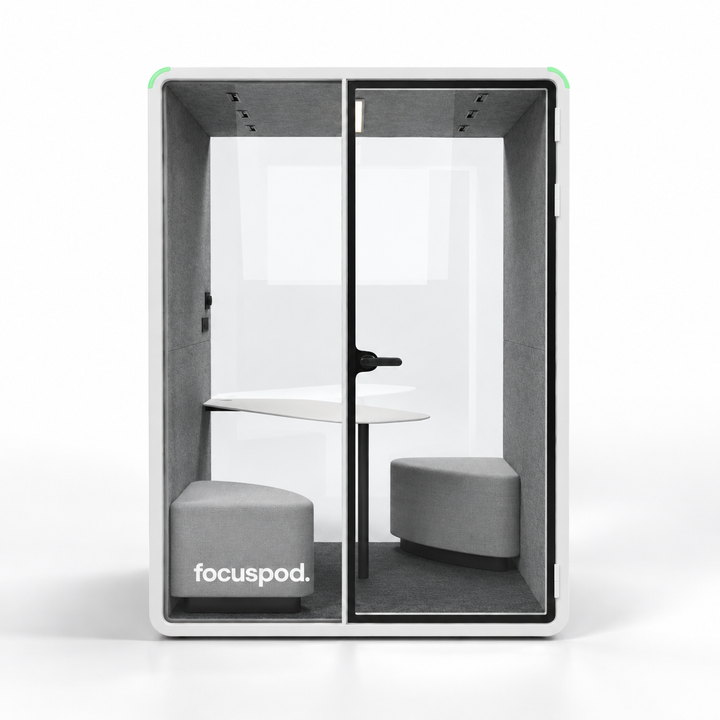 FocusPod Duo
R104,900 · Configure this model ↗
FocusPod Duo
R104,900 · Configure this model ↗ FocusPod Team
R109,900 · Configure this model ↗
FocusPod Team
R109,900 · Configure this model ↗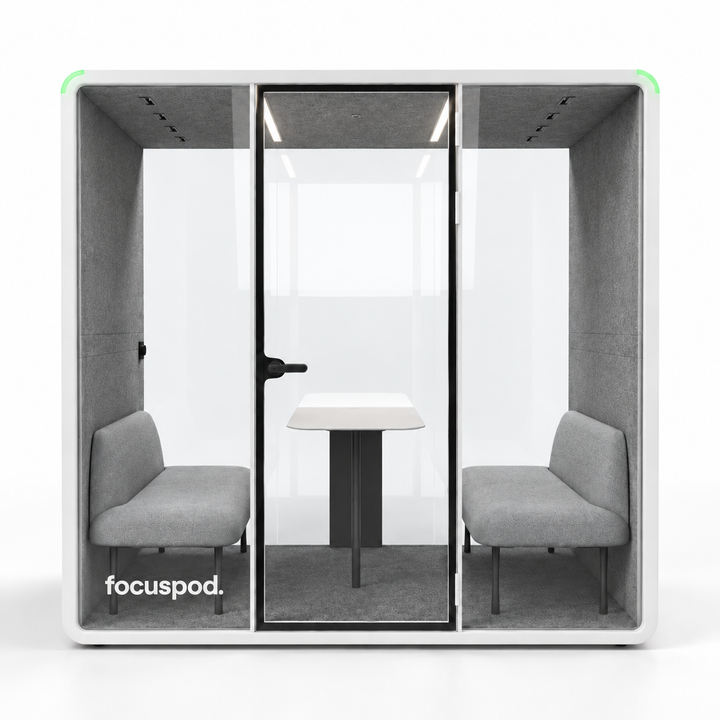 FocusPod Meet
R124,900 · Configure this model ↗
FocusPod Meet
R124,900 · Configure this model ↗ FocusPod Max
R159,900 · Configure this model ↗
FocusPod Max
R159,900 · Configure this model ↗


Six conversations that should not happen on the floor
Every contact centre we talk to has the same list, and it is worth naming it properly because it is what decides how many pods you actually need and which models.
Coaching and one-to-ones. A team leader running a side-by-side or a difficult performance conversation at a desk, within earshot of the agent's whole team, is the fastest way to make that conversation useless. This is the single most common reason a floor buys its first pods, and a two-person model covers it.
Escalations and complaints. The calls that need a calmer voice and no background chatter. A customer already unhappy, hearing forty other conversations behind your agent, draws a conclusion about your operation before anything is resolved.
Client calibration calls. If you run campaigns for offshore clients, someone is on a video call to the UK, the US or Australia every week, and the sound of your floor is the first thing that client experiences. A pod is a cheap way to make those calls sound like a professional operation.
Recruitment. South African contact centres hire continuously, and interviewing in a meeting room that is booked out, or at a desk, costs you candidates in a market where good agents have options. A pod is an interview room that does not need booking.
Quality assurance and dispute reviews. Listening back to a recording with an agent needs quiet to be fair to them, and privacy because the conversation is about their performance.
Verification and sensitive handling. Any call where an agent is reading back personal or payment information out loud. More on that below, because it is not only a noise question.
Count those roles rather than counting agents. A hundred-seat floor typically needs a handful of pods, not a hundred.
The noise numbers, since everyone quotes them and few explain them
A busy contact centre floor sits somewhere around 55 to 65 dB(A). Normal conversational speech is roughly 60 dB(A) measured a metre away. Those two figures being so close is the whole problem: your agents are talking at about the same level as the room they are talking in, which is why everyone raises their voice, and why the room gets louder through the shift.
A FocusPod is laboratory tested at greater than 29 dB of speech level reduction under ISO 23351-1, the standard written for pods rather than for walls. In practical terms, a conversation at normal speaking level inside the pod arrives outside it well below your floor's own background noise, which means it is not merely quieter, it is unintelligible. That is the thing that matters for a private conversation, and it is a different claim from simply being quieter.
Be careful with any supplier quoting a decibel figure without naming the standard. A number measured on a wall panel tells you nothing about an assembled pod with a door seal and a ventilation path.
Overheard conversations are also a data question
An agent reading a customer's identity number, account number or card details aloud, in a room where anyone can hear it, is a processing risk as well as a noise problem. Under POPIA, personal information has to be handled with appropriate safeguards, and "appropriate" is assessed against what was reasonably practical for you to do. If you take card details by phone, PCI DSS raises the same question in a different form.
We are not your lawyers and this is not legal advice. What we would say is that this is worth raising with whoever holds your information officer role before you decide where verification calls happen, because a physical control is one of the few answers available to an open-plan floor. If your client audits you, it is also one of the few you can show them.
What a pod actually draws, and what that means for backup power
This matters more here than in most markets, so here are the real numbers rather than a reassurance. These are the standard pod draws, before any optional cooling.
| Model | Capacity | Standard draw |
|---|---|---|
| Solo | 1 person | 40 W |
| Solo Plus | 1 person | 52 W |
| Duo | 2 people | 52 W |
| Team | 2 people | 60 W |
| Meet | Up to 4 people | 100 W |
| Max | Up to 6 people | 120 W |
To put that in context, a pod's lighting and ventilation draw less than a single desktop workstation. Six Solos together sit at around 240 W, which is inside the range of the inverter or UPS many floors already run for their network equipment. It plugs into a standard socket; there is no dedicated circuit and no electrical work in the building.
Two honest caveats. If you specify the air conditioning option, the draw is materially higher and it needs to be planned rather than assumed. And whatever the agent plugs in inside the pod, a laptop, a monitor, a headset base, is added on top of these figures. Tell us what will be used inside and we will give you a realistic total to take to whoever sizes your backup power.
Why a pod rather than building the rooms
Most contact centre space is leased, often on terms shorter than the campaigns that fill it. Building breakout rooms means a landlord conversation, a contractor, ceiling and services rework, and a making-good obligation at the end of the lease for rooms you will not take with you. If the campaign ends, the rooms stay and the cost stays with them.
A FocusPod is freestanding. It sits on levelling feet, is not fixed to the structure, needs no building work and no approval, and it moves. If you win a campaign and open a second floor, the pods go with the headcount. If you lose one, they are redeployed rather than written off.
We are not going to guess what a contractor would charge you to build the equivalent, because that number varies too much to publish honestly. Put your own quote into the calculator below and it will show you the difference against a real FocusPod project total.
Rolling it out on a live floor
A few things we have learned that are worth planning for. Put the first pods where the team leaders sit, not in a far corner, because utilisation follows proximity and an unused pod teaches everyone the wrong lesson. Pods are assembled in a morning, and on a 24-hour operation we schedule around your shift changeover so a working floor is not disrupted. If your building only allows deliveries out of hours, that is normal for us rather than something you have to negotiate.
On quantity, start smaller than you think and add. A floor that puts in four pods and finds them permanently occupied has learned something useful and can order more against a real number. A floor that orders twenty on a guess has not.
Our installers are insured, and we will complete whatever access registration your building or business park requires before the day. Indicative lead time is around four weeks from a confirmed order, with delivery and installation scheduled on top.
Every model, priced
No enquiry needed to see what this costs. Furniture and installation are separate lines, so you can see exactly what each part adds per pod and work out a cost per seat that holds up in a business case.
| Model | Capacity | Pod | Furniture package | Installation |
|---|---|---|---|---|
| Solo | 1 person | R79,900 | + R7,000 | + R15,000 |
| Solo Plus | 1 person | R99,900 | + R12,000 | + R20,000 |
| Duo | 2 people | R104,900 | + R12,000 | + R20,000 |
| Team | 2 people | R109,900 | + R16,000 | + R25,000 |
| Meet | Up to 4 people | R124,900 | + R29,900 | + R30,000 |
| Max | Up to 6 people | R159,900 | + R36,000 | + R40,000 |
Prices are for the pod in the configuration you choose. Finishes, furniture and compatible extras are listed separately as you build. Delivery, destination costs and any applicable tax are confirmed on your written quotation, so the total you approve is the total you pay.
Work out what your project actually costs
Choose the model and the quantity and you will have a real number in a few seconds. No enquiry, no email address, no waiting for someone to come back to you. Every figure below is the same one you will see in the configurator.
We do not guess what a builder would charge you. Put your own quote in and we will show you the difference against ours.
| Pods | — |
|---|---|
| Furniture | — |
| Installation | — |
| Project total | — |
Prices exclude VAT. Delivery to your address is confirmed on your written quotation.
- Over three years
- —
- Over five years
- —
— is what the deduction is worth at the rate you entered, bringing the effective cost to —. Indicative only, and not tax advice. How the wear and tear allowance works ↗
—
What is included as standard
Every FocusPod arrives with laminated glass front and rear, layered acoustic insulation, adjustable ventilation, dimmable LED lighting with adjustable colour temperature, power and an occupancy light. Speech level reduction is laboratory tested at greater than 29 dB under ISO 23351-1, the international standard written specifically for pods. Every pod is covered by our five-year structural and electrical warranty.


There is no separate charge for the black or white exterior or for the standard interior palette. Other exterior colours use the displayed upgrade price, and a custom interior colour is priced per pod. All of it is listed separately as you build, so nothing arrives as a surprise on the quotation.
See it properly before you decide
Take a look inside. The film below walks through the Solo, the most compact model in the range, and the 3D configurator lets you turn any model around, change the finishes and try the furniture layouts. If you would rather be walked through it, we will do a live video walkthrough of the pod you are considering and answer questions as we go.
Questions from contact centre operations
How many pods does a hundred-seat floor need?
Usually somewhere between four and eight, and the number comes from counting roles rather than agents: how many team leaders run coaching, how many escalations a day you handle, how often you interview, and whether client calls happen weekly or daily. Tell us those and we will give you a straight recommendation rather than the largest one.
Will a pod make the floor quieter overall?
Not materially, and we would rather say so. Taking a handful of conversations off the floor helps at the margin, but floor-wide noise is a different problem with different answers, including ceiling absorption and sound masking. What a pod solves is the conversation that needs privacy, which is a problem nothing else on the floor solves.
Can they run on backup power during load shedding?
Yes, subject to sizing. A Solo draws 40 W and a Max 120 W as standard, which is less than a typical workstation, so a handful of pods sits within the range of many existing inverter or UPS setups. Add whatever equipment is used inside, and plan separately if you specify the cooling option.
Do they need electrical work or landlord approval?
No. A pod plugs into a standard socket, is freestanding, sits on levelling feet and is not fixed to the building, so there is no construction, no approval to seek and nothing to make good at the end of the lease.
Can we move them to another site later?
Yes, and this is one of the main reasons operations teams choose pods over built rooms. They can be dismantled and reassembled. Tell us if a relocation is likely and we will make sure the configuration suits it.
Can I see one before we commit?
Yes. Turn any model around in the 3D configurator, watch the product films, and if you would like to be walked through it, we will do a live video walkthrough of the pod you are considering and answer questions as we go. Send us your floor plan beforehand and we will talk through placement.
Are the front and rear both glass?
Yes. Every FocusPod has glass at both the front and rear. Standard glass is clear. Optional PDLC privacy glass can be selected for the front only or for both the front and rear.
Can I move the pod once it is installed?
Yes. Every FocusPod has built-in wheels and adjustable levelling feet. Raise the feet to move the pod on its wheels, then lower and adjust them to level the pod in its new position.
Start with the roles, not the headcount
Count the conversations that currently have nowhere to happen. That number, not your seat count, is how many pods you need. Build the configuration, see the price, and send us the floor plan with your shift pattern and access details, and the quotation comes back complete.